GITA
“Beyond the clamor of the battlefield, lies the song of the eternal soul.”
कर्मण्येवाधिकारस्ते मा फलेषु कदाचन |
“”
Contemplate
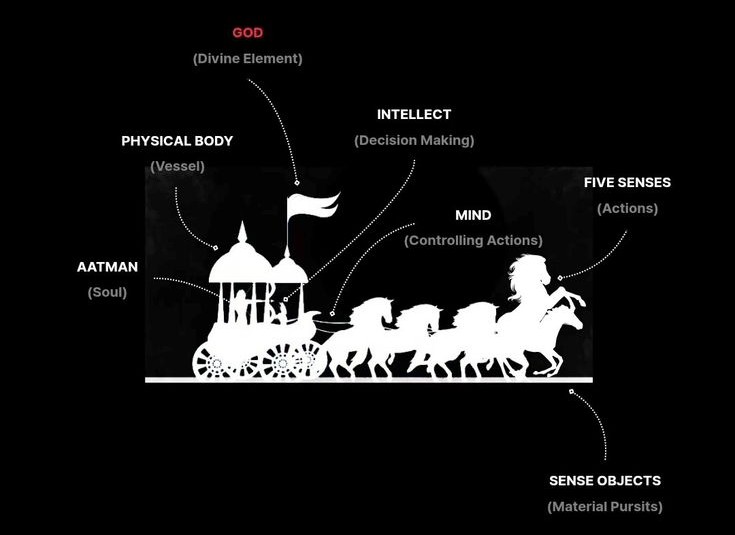
The Architecture of Self Consciousness
Katha Upanishad & Shrimad Bhagavad Gita
Hanuman on the Flag
(Kapidhwaja)
Unshakable Faith & Stability
Hanuman symbolizes absolute faith and devotion. Even when the senses become restless and chaotic, strong faith (Shraddha) keeps the chariot balanced and prevents collapse.
The Rider
(Atman)
The Seeking Soul
Arjuna represents the human being—the pure soul who is currently confused and emotionally overwhelmed, seeking clarity and purpose on the battlefield of life.
The Charioteer
(Buddhi)
Divine Intellect / Higher Wisdom
Krishna represents Divine Intelligence. When personal intellect is clouded by fear, surrendering to higher wisdom allows life to move in the right direction.
The Reins
(Manah)
Control Mechanism
The mind acts as the reins. If it is loose or undisciplined, the senses will pull the chariot toward temporary emotions, cravings, and distractions.
The Horses
(Indriyas)
Sensory Power
The five horses represent Sight, Hearing, Smell, Taste, and Touch. Untrained senses dominate life. The goal is not to destroy them, but to train them into a driving force.
The Road
(Vishayas)
The Material Fields (like Attraction, Temptation, etc.)
The road represents the material world and its endless sense objects. The road is neutral; it is our focus that determines if the journey reaches its destination.
The Master Insight
"Only a strong Intellect (Krishna) can hold the Mind steady. When Divine Wisdom leads the chariot, the Soul remains peaceful even amidst the roar of battle."
Why the Gita?
मनोनिग्रह (Mano-nigraha)
Mastery of Mind
In an age of digital distraction, the Gita provides the blueprint to tighten the 'reins' of the mind, transforming it from your worst enemy into your greatest friend.
निष्काम कर्म (Nishkama Karma)
Fearless Action
By teaching focus on the process rather than the result, it eliminates the anxiety of failure and the burnout of modern 'hustle culture'.
स्थितप्रज्ञ (Stithapragya)
Clarity in Chaos
When life feels like a battlefield of choices, the Gita provides a framework for the Intellect to remain stable in both success and defeat.
"The Gita is not a book of commands, but a book of choices. It does not tell you what to do; it tells you who you are."
The Human Manual
Acting when every option hurts.
The Gita doesn't solve the world's problems. It solves the **person facing them**. It is the ultimate guide to remaining unmoved in the storm.
"Yathecchasi Tathā Kuru—Do as you choose."
Bhagavad Gita 18.63
Life Is Conflict
The Gita exists because being 'good' is not enough when life becomes a paradox. It meets you at your breakdown.
Clarity, Not Comfort
Most teachings promise relief; the Gita gives vision. It doesn't say 'it will be fine,' it says 'see reality clearly.'
Inner Transformation
Krishna doesn't change the war; he changes Arjuna. When the observer changes, the observed world shifts.
Action in the World
It doesn't ask you to renounce society, but to stand where you are, act rightly, and let go inwardly.
Total Integration
A manual that integrates your Thinking (Jnana), Acting (Karma), and Feeling (Bhakti) into one force.
Human Freedom
No coercion. Krishna’s final words respect your intelligence: 'Reflect fully, then do as you choose.'
Timeless Context
Kurukshetra is your office, your home, your mind. Arjuna is you. The problem of the soul is eternal.
Inquiry Over Belief
Belief is optional; inquiry is not. Approach it as psychology, ethics, or pure philosophy.
"The Gita teaches how to act without losing oneself in the noise of the result."
Voices of Kurukshetra
Every character on the battlefield represents a specific faculty of the human psyche. The war is not external; it is the eternal dialogue of the Self.
The Divine Charioteer
Shri Krishna
The supreme teacher who does not fight but guides. He represents the inner voice of wisdom that remains stable amidst chaos.
The Higher Intelligence
The Seeking Warrior
Arjuna
The world-class archer who collapses under moral complexity. He represents every human who faces a crisis of identity.
The Individual Soul
The Divine Visionary
Sanjaya
Gifted with 'Divya-Drishti' (Divine Vision), he narrates reality without bias. He represents pure, non-judgmental awareness.
The Objective Witness
The Blind King
Dhritarashtra
Physically and spiritually blind, he represents a mind blinded by attachment to its own creations and selfish desires.
The Bound Ego
The Grandsire
Bhīṣma
Invincible patriarch bound by a vow. He represents the weight of outdated traditions that we struggle to transcend.
Ancient Tradition
The Royal Teacher
Droṇācārya
The master of arms. He represents intellectual talents and skills that can unfortunately be used to serve the ego.
Acquired Skill
The Crown Prince
Duryodhana
Consumed by jealousy, he represents the 'Desire-Mind' that will destroy anything to maintain its perceived power.
Unbridled Desire
The Virtue Collective
Pandavas
The five brothers representing various aspects of virtue: Truth, Strength, Patience, Wisdom, and Beauty.
Dharma
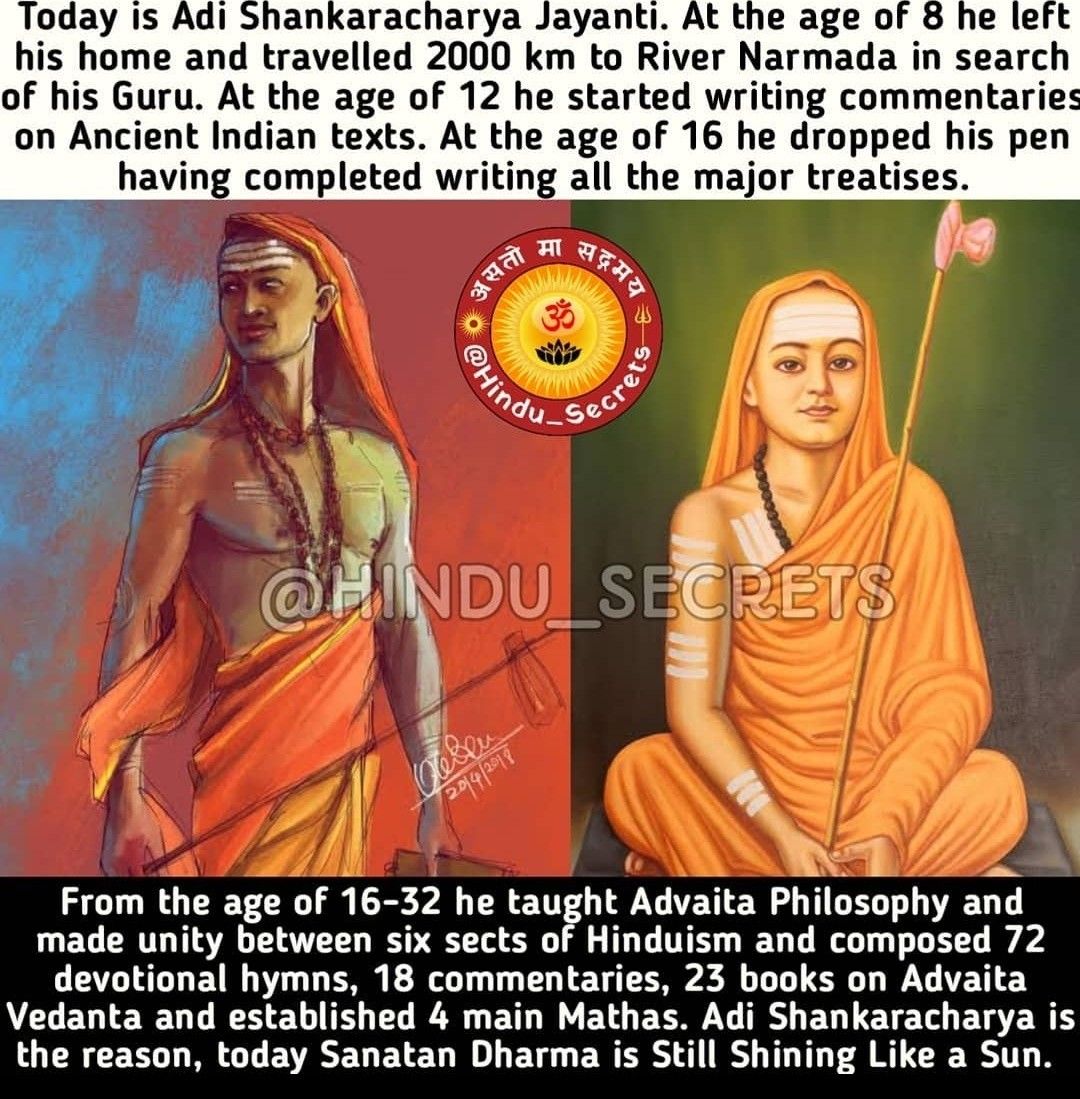
The Sovereign Lineage
Distilled by
Adi Shankara
In the 8th Century, a single master consolidated the diverse recensions of the Mahabharata (Śatasahasrī Saṃhitā ) into the 700-verse standard we hold sacred today.
Through his monumental commentary, he shifted the perception of the Gita from a regional heroic song to the universal roadmap for the liberation of the individual soul.
"The Gita is the pure milk of the Upanishads, drawn for the benefit of humanity."
The Sacred Lineage
I. Literary Descent
The Mahābhārata
The Infinite OceanA sprawling epic of 100,000 verses. It represents the totality of human experience—politics, war, and family.
100K VersesBhīṣma Parva
The Strategic PauseThe 6th book of the epic. Amidst the movement of armies, the narrative stops to address the crisis of the soul.
Book 6Vyāsa Paramparā
The Seer's VisionPreserved through 'Smṛti' (divine memory), Maharshi Vyāsa distilled the Vedic essence into this 700-verse dialogue.
Oral TraditionII. Philosophical Unification
The Gita is the Master Key, bridging contradictory ancient traditions into a single path of action.
Chronological Context
Composed between 500 BCE – 200 BCE, marking the pivotal transition from Vedic ritualism to Classical Yoga.
The Commentary Lineage
Adi Shankaracharya
The Essence
“The soul and the Supreme are one. The world is an illusion (Maya) that hides this absolute unity.”
Historical Legacy
Standardized the 700 verses; revived Vedic thought via pure logic.
The Path of Eighteen
Arjuna Viṣāda Yoga
“The Yoga of Dejection”
Sāṅkhya Yoga
“The Yoga of Knowledge”
Karma Yoga
“The Yoga of Action”
Jñāna Karma Sannyāsa
“The Yoga of Renunciation”
Karma Sannyāsa Yoga
“The Yoga of True Renunciation”
Dhyāna Yoga
“The Yoga of Meditation”
Jñāna Vijñāna Yoga
“The Yoga of Realization”
Akṣara Brahma Yoga
“The Yoga of the Imperishable”
Rāja Vidyā Yoga
“The Yoga of Royal Secrets”
Vibhūti Yoga
“The Yoga of Divine Glories”
Viśvarūpa Darśana
“The Vision of the Universal Form”
Bhakti Yoga
“The Yoga of Devotion”
Kṣetra Kṣetrajña
“The Field and its Knower”
Guṇatraya Vibhāga
“The Three Gunas of Nature”
Puruṣottama Yoga
“The Yoga of the Supreme Person”
Daivāsura Sampad
“Divine and Demoniac Natures”
Śraddhātraya Vibhāga
“The Threefold Faith”
Mokṣa Sannyāsa Yoga
“Final Liberation”